Brahma Muhurta | Time & Timing — Today & Tomorrow
Brahma Muhurta is the sacred pre-dawn window the yogic and Ayurvedic traditions hold to be the most auspicious stretch of the entire day for meditation, study and sadhana. Because it is tied to sunrise, the Brahma Muhurta time shifts slightly every day and differs by location — so the window that falls for you this morning is not quite the same as Brahma Muhurta time tomorrow. This guide explains the definition, shows you how to find the correct brahmamuhurta timing for today and tomorrow, and walks through the benefits, the science, and exactly what to do once you are awake.

What Is Brahma Muhurta? (Definition & Meaning)
The word joins two Sanskrit terms: Brahma, the creative principle or the Absolute, and muhurta, a traditional unit of time. The Brahma Muhurta meaning is usually rendered as "the time of Brahma" or "the Creator's hour" — the moment when creation itself is said to stir and the mind is naturally at its clearest. In the Vedic reckoning of time, the night is divided into fifteen muhurtas of roughly 48 minutes each, and it is the fourteenth — the penultimate muhurta before dawn.
So Brahma Muhurta in English is best described not as a fixed clock time but as a window — a sacred pre-dawn hour: the pre-dawn stretch when the world is still, the air is fresh, and the mind has not yet been pulled into the day's activity. For a practitioner, it is the single most valued hour of the twenty-four — which is exactly why so many people search for the exact Brahma Muhurta time for their own city and day.
Brahma Muhurta Time & Timing: How It Is Calculated
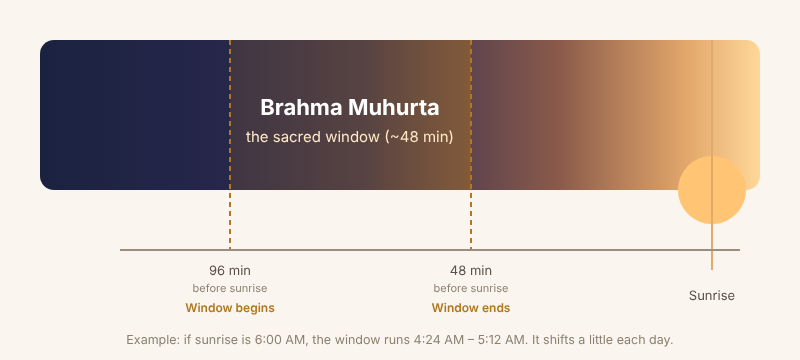
Here is the part that surprises most people: there is no universal Brahma Muhurta time. The correct brahmamuhurta timing is worked out from your local sunrise, so it changes with your latitude, your longitude, and the day of the year. The traditional calculation is straightforward:
- Brahma Muhurta begins about 1 hour 36 minutes (96 minutes) before sunrise.
- Brahma Muhurta ends about 48 minutes before sunrise.
- The Brahma Muhurta duration is therefore roughly 48 minutes — one full muhurta.
A worked example makes the brahma muhurta time period clear. If sunrise in your city is at 6:00 AM, then your window runs from about 4:24 AM to 5:12 AM. If sunrise shifts to 6:20 AM tomorrow, the whole window moves with it — which is precisely why the Brahma Muhurta time today and Brahma Muhurta time tomorrow are rarely identical. In winter, sunrise is later, so this window falls later in the morning; in summer it comes earlier.
Find Your Exact Brahma Muhurta Time Today & Tomorrow
Rather than rely on a fixed figure, it is far more accurate to calculate this window from your own coordinates. Our free Brahma Muhurta calculator shows the exact Brahma Muhurta time in my location instantly — no sign-up, no download — and the Brahma Muhurta calendar lets you see the window month by month so you can plan ahead. For a quick city-by-city reference, see Brahma Muhurta time by city, which lists today and tomorrow's window for major locations.
If you would rather it appear automatically each morning, the SereneRise app places today's exact brahma muhurta time on a home-screen widget and updates it at midnight for the coming day, so the correct daily Brahma Muhurta time is always a glance away — including today brahma muhurta time and tomorrow Brahma Muhurta time without any manual calculation.
SereneRise shows today's exact pre-dawn window on your home screen, calculated from your precise location and updated automatically — no ads, no account, fully offline.
Why Brahma Muhurta Matters: The Significance
The significance of this pre-dawn hour rests on a simple observation that both the Ayurvedic texts and modern chronobiology share: the pre-dawn hour is unlike any other. The importance of the window comes from a rare alignment of conditions — the environment, the body and the mind are all at their most receptive at once.
- A quiet, sattvic environment. Before the world wakes, the air is clean and still, free of the noise and restlessness that build through the day.
- A rested, uncluttered mind. You emerge from sleep before fresh worries crowd in, so attention settles far more easily — one reason meditation in Brahma Muhurta is prized.
- A body in its natural rhythm. The digestive system is still at rest and the breath is naturally slow and even, which the tradition considers ideal for pranayama and inner work.
This is why the texts say spiritual effort made now carries further than the same effort made later. The teacher Sadhguru of the Isha Foundation describes it as a time when the human system is especially poised for inner growth — a recurring theme whenever people look up Sadhguru on Brahma Muhurta. The power of Brahma Muhurta, in short, is that it gives you the day's calmest, clearest hour before anything has had a chance to disturb it.
The Science Behind the Pre-Dawn Hour
The Brahma Muhurta science is more than poetry. The 2017 Nobel Prize in Physiology or Medicine was awarded for work on the body's circadian clock — the internal timing system that governs sleep, hormones and alertness. In the pre-dawn window, cortisol begins its natural morning rise (the cortisol awakening response), melatonin tapers off, and the mind moves toward wakeful clarity. Rising gently now tends to align you with that rhythm rather than fighting it. We explore the studies in depth in the science behind Brahma Muhurta.
Watch: The Significance of Brahma Muhurta
In this talk, Dr. Hansaji Yogendra of The Yoga Institute explains the significance of Brahma Muhurta and the benefits of waking early — a clear, practical introduction to the pre-dawn window:
"The Significance of Brahma Muhurta" — The Yoga Institute (Dr. Hansaji Yogendra)
Benefits of Brahma Muhurta
The benefits of Brahma Muhurta are both practical and spiritual. Practitioners who make rising in this window a daily habit commonly report:
- Deeper, easier meditation. The quiet mind makes the benefits of meditation in Brahma Muhurta noticeably greater than at busier hours of the day.
- Sharper focus and memory. Students have long favoured this hour for study, when retention is at its best.
- Emotional steadiness. Beginning the day calmly, before the rush, sets a settled tone that carries through.
- A sense of time and space. A quiet head-start makes the whole day feel less hurried.
- Alignment with nature's rhythm. Rising with the approaching sun supports healthy sleep and energy — part of the broader benefits of waking up at Brahma Muhurta people describe.
It is worth being honest about one point: the deepest brahma muhurta wake up benefits come from rising naturally and gently, not from being jolted awake. The surest way to wake in time is to go to bed earlier — the tradition treats early sleep and early rising as two halves of the same practice.
What to Do in Brahma Muhurta
Knowing the window is only half of it; the other half is using it well. Here is what to do in Brahma Muhurta, roughly in order:
- Wake gently and freshen up. Rise without a jarring alarm if you can, drink a little water, and wash.
- Sit for meditation. Even ten quiet minutes of meditation (in Gyan Mudra or Dhyan Mudra) during Brahma Muhurta set the tone for the whole day.
- Practise pranayama. Slow, conscious breathing suits the calm air of this hour.
- Do gentle yoga. A little yoga in Brahma Muhurta — a few rounds of Surya Namaskar — warms the body as the sun approaches.
- Chant or do japa. Mantra repetition is traditionally recommended now; count your rounds with our online mantra counter.
- Set an intention. A moment of quiet reflection or reading before the day begins.
For a fuller routine, see what to do in Brahma Muhurta: yoga, pranayama & routine and our guide to Brahma Muhurta meditation.
Brahma Muhurta Routine: A Simple Daily Template
A workable Brahma Muhurta routine need not be elaborate. The key is consistency — the pre-dawn practice becomes a habit only when you protect it. A simple template for the brahma muhurta time everyday:
- The night before: finish dinner early, wind down, and sleep by around 10 PM.
- Check your window: glance at your exact morning brahma muhurta time on the SereneRise widget or the online tool.
- In the window: meditation → pranayama → light yoga → japa, as time allows.
- As the sun rises: close with gratitude, then move into your day.
Common Mistakes: Dos and Don'ts
A few simple missteps keep people from getting the most out of the pre-dawn hour. Keeping these in mind makes the practice far more rewarding:
- Don't rely on a fixed clock time. A time that worked last month may be wrong today, because the window tracks sunrise. Always check the current exact Brahma Muhurta time for your location rather than assuming a round figure like "4 AM".
- Don't jolt yourself awake. A blaring alarm undoes the calm the hour is meant to build. Going to bed earlier is the real key — treat early sleep and early rising as one practice.
- Don't fill the window with your phone. Scrolling pulls the mind straight into the day's noise and wastes the stillness. Keep the screen off until your practice is done.
- Do keep it consistent. The effect compounds with regularity; a steady daily rhythm matters more than an occasional perfect morning.
- Do start small. Ten focused minutes is worth more than an hour you dread. Build gradually.
- Do practise on an empty stomach. The body's rest-and-digest state in this hour suits meditation and pranayama; heavy food beforehand works against it.
Textual & Traditional Origins
The reverence for this hour is woven through the yogic and Ayurvedic traditions. Ayurveda's classical daily-routine framework, dinacharya, explicitly recommends rising in the pre-dawn window to preserve health and clarity — guidance set down in texts attributed to the physician Vagbhata, the Ashtanga Hridayam among them. The division of the night into fifteen muhurtas, from which the brahmamuhurta timing is derived, belongs to the Vedic system of timekeeping. Across these sources the message is consistent: the quiet hour before sunrise is set apart for the mind's highest work. Modern teachers continue the theme — the Isha Foundation and the Art of Living both point seekers to this window as the most fertile time for inner practice, echoing what the old texts say in contemporary language.
Frequently Asked Questions
What is the exact Brahma Muhurta time today?
There is no single fixed time — the exact Brahma Muhurta time today depends on your local sunrise. It begins about 96 minutes before sunrise and ends about 48 minutes before. Use the Brahma Muhurta calculator to get the precise window for your location.
Is Brahma Muhurta time tomorrow the same as today?
Almost, but not exactly. Because sunrise shifts a little each day, the Brahma Muhurta time tomorrow usually differs from today's by a few minutes. The SereneRise widget updates automatically at midnight so tomorrow's window is ready for you.
How long is Brahma Muhurta? (Brahma Muhurta duration)
The Brahma Muhurta duration is one muhurta — roughly 48 minutes. It is the fourteenth of the night's fifteen muhurtas, ending about 48 minutes before sunrise.
What is 1 muhurta in minutes?
One muhurta is approximately 48 minutes. The day and night together contain thirty muhurtas of 48 minutes each, which is how the traditional brahmamuhurta timing is derived.
What is the meaning of Brahma Muhurta?
The meaning of Brahma Muhurta is "the time of Brahma" or "the Creator's hour" — Brahma (the creative principle) plus muhurta (a unit of time). It names the pre-dawn window considered most auspicious for spiritual practice.
What are the benefits of waking up in Brahma Muhurta?
Reported benefits of waking up in Brahma Muhurta include deeper meditation, sharper focus and memory, emotional steadiness, and better alignment with the body's natural rhythm. The benefits are greatest when you rise gently rather than being startled awake.
What should I do in Brahma Muhurta?
The classic practices are meditation, pranayama, gentle yoga, and japa (mantra repetition), along with quiet reflection. See our guide to what to do in Brahma Muhurta.
Why does the Brahma Muhurta time change in winter?
Because it is tied to sunrise, the Brahma Muhurta time in winter falls later in the morning (sunrise is later) and earlier in summer. A location-based calculator keeps it accurate year-round.
Sources & Further Reading
- Brahmamuhurta — Wikipedia (definition, timing and the muhurta system)
- Muhurta — Wikipedia (the Vedic unit of time)
- Brahma-muhūrta — Wisdomlib (scholarly definitions from the classical texts)
- Brahma Muhurta — The Time to Create Yourself (Sadhguru, Isha Foundation)
- What is Brahma Muhurta — The Art of Living
- Dinacharya — Wikipedia (the Ayurvedic daily routine that prescribes pre-dawn rising)