Circadian Rhythm: Your Body's 24-Hour Clock and How to Align With It
Every living thing keeps time. Deep in the brain, a biological clock ticks through a roughly 24-hour cycle, shaping when you feel awake, when you feel sleepy, when hormones surge and when the body repairs itself. This internal timekeeper is your circadian rhythm — and learning to live in step with it is one of the simplest, most powerful things you can do for your sleep, energy and wellbeing.
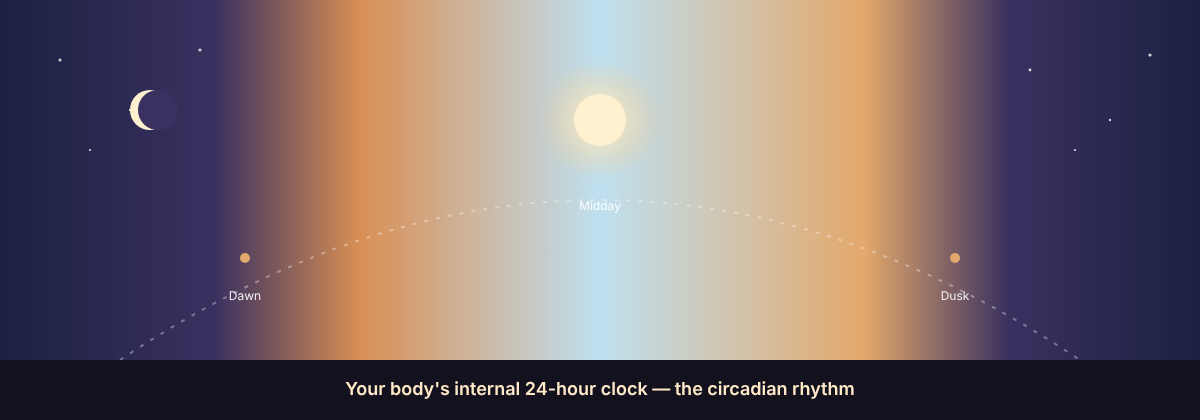
What Is the Circadian Rhythm?
The word comes from the Latin circa diem — "about a day." A circadian rhythm is any physical, mental or behavioural change that follows a roughly 24-hour cycle, driven by an internal clock and tuned by cues from the environment. Humans have one, but so do animals, plants and even single-celled organisms. The best-known circadian rhythm is the sleep–wake cycle, yet the same internal timing also governs body temperature, hormone release, digestion, blood pressure, alertness and cell repair.
The crucial point is that the circadian rhythm is internal. Even in total darkness, with no clock and no sunlight, your body would keep running on an approximately 24-hour schedule. But that internal clock is not perfectly 24 hours on its own — it needs to be reset each day by external signals, above all light. When the clock is well-synchronised, you feel alert by day and sleepy at night. When it drifts out of sync, everything from mood to metabolism can suffer.
The Master Clock: How Your Circadian Rhythm Works
At the centre of the system sits a tiny cluster of around 20,000 nerve cells in the hypothalamus, called the suprachiasmatic nucleus (SCN). This is the body's master clock, and it conducts the whole orchestra. According to the US National Institute of General Medical Sciences, the SCN sits just above the point where the optic nerves cross — perfectly placed to receive information about light entering the eyes.
Light is the single most important signal, or zeitgeber ("time-giver"), that sets the circadian rhythm. When morning light reaches special cells in the retina, the SCN registers that the day has begun and synchronises the body's clocks accordingly. As darkness falls, the opposite happens and the body prepares for rest. This is why the body clock is so tightly bound to the natural cycle of sunrise and sunset — the clock evolved over millions of years under an open sky, long before artificial light existed.
Remarkably, the SCN is not the only clock. Nearly every organ and tissue has its own "peripheral" circadian rhythm, and the master clock keeps them all coordinated — your liver, gut and even your skin run on daily schedules of their own.
The 2017 Nobel Prize: The Genes Behind the Clock
For a long time the circadian rhythm was observed but not understood at a molecular level. That changed with the work recognised by the 2017 Nobel Prize in Physiology or Medicine, awarded to Jeffrey C. Hall, Michael Rosbash and Michael W. Young "for their discoveries of molecular mechanisms controlling the circadian rhythm." Studying fruit flies, they isolated a gene that encodes a protein which builds up in cells during the night and breaks down during the day — a self-winding molecular clockwork that runs inside individual cells.
This was a landmark moment. It showed that the body clock is not a vague tendency but a precise, genetically programmed mechanism operating in essentially every cell of the body. The discovery helped explain why disrupting your natural rhythm — through shift work, jet lag or chronic late nights — has such wide-ranging effects on health.
Melatonin and Cortisol: the Hormones of the Circadian Rhythm
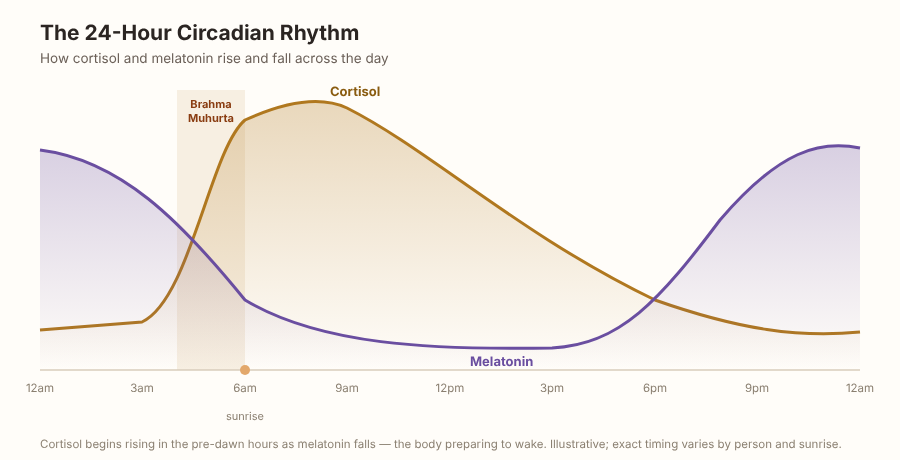
The body clock expresses itself most clearly through two hormones that rise and fall in opposition across the day.
- Melatonin — often called the "hormone of darkness." As evening light fades, the SCN signals the pineal gland to release melatonin, which makes you feel drowsy and ushers in sleep. Melatonin stays high through the night and falls as dawn approaches.
- Cortisol — the "hormone of alertness." Cortisol follows the opposite curve: it is low at night, begins climbing in the pre-dawn hours, and peaks shortly after waking in what scientists call the cortisol awakening response. This surge helps rouse the body and mobilise energy for the day.
Why the Pre-Dawn Hours Matter
Look closely at that curve and something interesting appears. In the stretch of time before sunrise, the body is already shifting gears: melatonin is receding, cortisol is on the rise, and the body is moving naturally from deep rest toward wakefulness. Core body temperature, which bottoms out in the small hours, begins to climb. In other words, the pre-dawn window is not dead time — it is a threshold the circadian rhythm crosses every single morning.
Rising gently in this window means waking with the body's own rising tide of alertness rather than against it. This simple idea — that there is an optimal time to wake, written into our physiology — was understood, in its own language, thousands of years before anyone sequenced a clock gene.
What Disrupts Your Circadian Rhythm
Because the body clock depends on a consistent cycle of light and dark, modern life is unusually good at throwing it off. According to the Sleep Foundation, a misaligned circadian rhythm is linked with poorer sleep, lower daytime function and a range of health concerns. The common culprits:
- Artificial light at night. Bright indoor lighting and the blue light from phones and screens trick the SCN into thinking it is still daytime, suppressing melatonin and pushing the whole clock later.
- Irregular schedules. Going to bed and waking at wildly different times — "social jet lag" — leaves the clock without a stable anchor.
- Shift work. Working through the night forces the body to be alert when its internal clock is calling for sleep, one of the most studied forms of clock disruption.
- Jet lag. Crossing time zones faster than the clock can adjust leaves your internal time out of step with local time.
- Too little morning light. Without a strong morning light signal, the clock has nothing firm to reset against and tends to drift.
Brahma Muhurta: Ancient Wisdom That Mirrors the Science
Long before chronobiology, the yogic and Ayurvedic traditions of India identified a special window in the pre-dawn hours and called it Brahma Muhurta — roughly 96 to 48 minutes before sunrise. The texts held this to be the most auspicious time of day for meditation, study and spiritual practice, and prescribed rising within it. What is striking is how neatly that ancient instinct maps onto what we now know about the circadian rhythm: it points to exactly the threshold where cortisol rises, melatonin falls and the mind grows naturally clear.
You can read the full tradition and timing in our guide to Brahma Muhurta — definition, time and benefits, and we explore the research in depth in the science behind Brahma Muhurta. Because the window is tied to your local sunrise, it shifts slightly each day — you can find today's exact window with our free Brahma Muhurta calculator or plan ahead with the Brahma Muhurta calendar. If you would rather it simply appear each morning, the SereneRise app places today's window on your home screen, calculated from your exact location.
The point is not that ancient sages knew about melatonin. It is that, through careful observation of the body and the sky, they arrived at a practice that honours the circadian rhythm — waking with the light, in the window when the body is already preparing to rise. For a fuller routine, see what to do in Brahma Muhurta and our guide to Brahma Muhurta meditation.
Watch: How Your Body Clock Works
This short explainer from SciShow walks through how the circadian rhythm is run by the brain's master clock — a clear, visual introduction to the science above:
"Circadian Rhythm and Your Brain's Clock" — SciShow
How to Support a Healthy Circadian Rhythm
The good news is that the body clock responds well to consistent, simple habits. You do not need special equipment — you need to give your clock clear, regular signals. The essentials:
- Get morning light early. Natural light soon after waking is the strongest anchor for the body clock. A few minutes outdoors in the morning tells the master clock the day has begun.
- Keep a consistent schedule. Going to bed and waking at the same times — even on weekends — gives the clock the stability it needs. Rising early and regularly is central to this, which is exactly what traditions built around the pre-dawn hour encourage.
- Dim the lights at night. Reduce bright and blue light in the evening so melatonin can rise on schedule. Screens an hour before bed are the most common obstacle.
- Wind down and sleep earlier. An earlier night is the surest way to wake refreshed in the morning window, when the circadian rhythm is already tilting toward wakefulness.
- Be mindful of timing. Large meals, caffeine and intense exercise late in the day can all nudge the clock later. Front-load them where you can.
None of this is new. It is, in modern terms, the same counsel the old traditions gave: sleep early, rise with the approaching sun, and begin the day in the quiet pre-dawn window. If you are curious how that hour is calculated where you live, our Brahma Muhurta time by city reference lists it for major locations.
SereneRise shows your exact pre-dawn window each morning — calculated from your precise location, updated daily, no ads or account. A simple way to align your wake-up with your circadian rhythm.
Frequently Asked Questions
What is the circadian rhythm in simple terms?
The circadian rhythm is your body's internal 24-hour clock. It controls when you feel awake and sleepy, and times processes like hormone release, body temperature and digestion across the day, tuned mainly by light and dark.
What controls the circadian rhythm?
A master clock in the brain called the suprachiasmatic nucleus (SCN) controls the circadian rhythm. It responds to light entering the eyes and coordinates clocks throughout the body, largely through the hormones melatonin and cortisol.
How do I reset my circadian rhythm?
The most effective way to reset the circadian rhythm is consistent morning light exposure, a regular sleep and wake schedule, dim light in the evening, and an earlier bedtime. Changes take a few days to take hold as the clock re-anchors.
How is Brahma Muhurta related to the circadian rhythm?
Brahma Muhurta is the pre-dawn window (about 96–48 minutes before sunrise) that yogic tradition prized for practice. It falls exactly where the circadian rhythm shifts toward waking — cortisol rising, melatonin falling — so rising then means waking with the body's natural rhythm. See the science behind Brahma Muhurta.
Does the circadian rhythm change with the seasons?
Yes. Because light is the main signal, the circadian rhythm shifts with changing sunrise and sunset times through the year. This is also why the Brahma Muhurta window falls later in winter and earlier in summer.
Sources & References
- The Nobel Prize in Physiology or Medicine 2017 — NobelPrize.org (molecular mechanisms controlling the circadian rhythm)
- Circadian Rhythms fact sheet — NIH / NIGMS
- What Is Circadian Rhythm? — Sleep Foundation
- Circadian rhythm — Wikipedia
- Suprachiasmatic nucleus — Wikipedia